

And then experimentation would be in order that would allow every kind of heroism to find satisfaction – centuries of experimentation that might eclipse all the great projects and sacrifices of history to date.
--Nietzsche, The Gay Science
The futurist impulse
Patrick Collison and Tyler Cowen’s “New Aesthetics” RFP calls for architectural and design aesthetics adequate to the present, and for futurism rather than yet more retrofuturism. The instinct is right: our moment is saturated with futurist rhetoric yet has failed to generate its own compelling spatial visions. We inhabit an age of upheaval and possibility, yet this is constrained by a persistent conservatism. This restraint is cultural, intellectual, and political; it reasserts itself at each new advance. It is sustained both by individuals and institutions invested in the maintenance of existing forms, and by a more impersonal entropic pull, dragging the emergent to collapse back into the Same.
Though often associated with Italian Futurism, Renato Poggioli argues that the futurist impulse belongs to all avant-gardes. Marinetti named a deeper, recurring attitude that appears when inherited forms no longer hold and technological change accelerates beyond existing symbolic orders. D. H. Lawrence for his part described futurism as an inhuman, vitalist will. Where conservatism seeks to arrest metamorphosis through retreat to imagined pasts —ancient Greece, 90s cul-de-sac— the futurist impulse moves in the opposite direction. It embraces the speed of the present, invents new forms, and wants life intensified rather than merely preserved and repeated. From this perspective, the only worthwhile task is to open the door to the unknown and walk through it.
This futurist–conservatist tension is felt sharply in America today. Immense technological, cultural, even spiritual potential coexists with stagnation: Starships and AI hallucinations alongside inertia, falling birth rates, and attempts to compress maneuver space in a genuinely revolutionary situation to a return to pre-2008 political equilibrium. “These are the days of miracle and wonder — don’t cry baby don’t cry.”
America has long identified as “the great nation of futurity” but reattaching this myth to reality would require jettisoning nostalgia and reorienting toward new, dynamic –especially spatial—forms. The question is whether the hypomanic spirit (daemon) that once drove American invention and risk remains alive –can your genius abandon you?— or whether the nation now lives inside simulations and feedback loops, with no clear future to orient toward and no means of reaching it.
Rather than proposing specific designs, the New Aesthetics call prompts reflection on how new culture and aesthetics become possible at all. The problem may not be a lack of imagination or even “new aesthetics” per se, but a failure to reconstruct the conditions under which worthy forms can emerge. One way to approach these problems is by looking at earlier futurist attempts – not as styles to repeat or revive but as moments when perception, thought, and form were forced back into question and reconstituted through experiment. These efforts help bring the present into focus.
Where our restless activities might unfold
Italian Futurism raised the antitraditionalist impulse to its most polemical and antagonistic intensity. Composed of young painters, poets, architects, writers, and filmmakers, it emerged before World War I as a revolt against the cult of the past in a world reorganized by machines and speed. They rejected the necrophilia of tradition and the museumification of life, and they opposed romantic sentimentality, bourgeois softness, and slowness, including in cities.
Not enough is known about the Futurists’ urban and architectural interventions. Marinetti’s 1910 manifesto Against Passéist Venice, hurled from the clock tower in St. Mark’s Square, denounced the city as a moribund museum (a “great sewer of traditionalism”) choking on antiquities and sentiment. It called for burning the city’s gondolas (“rocking chairs for idiots”), filling its canals with the ruins of collapsing palaces, and tearing Venice from its decadent tourist dream into the harsh light of new technology, and aggressively revivifying its citizens by refounding the city as a commercial-military, aqua-industrial power.
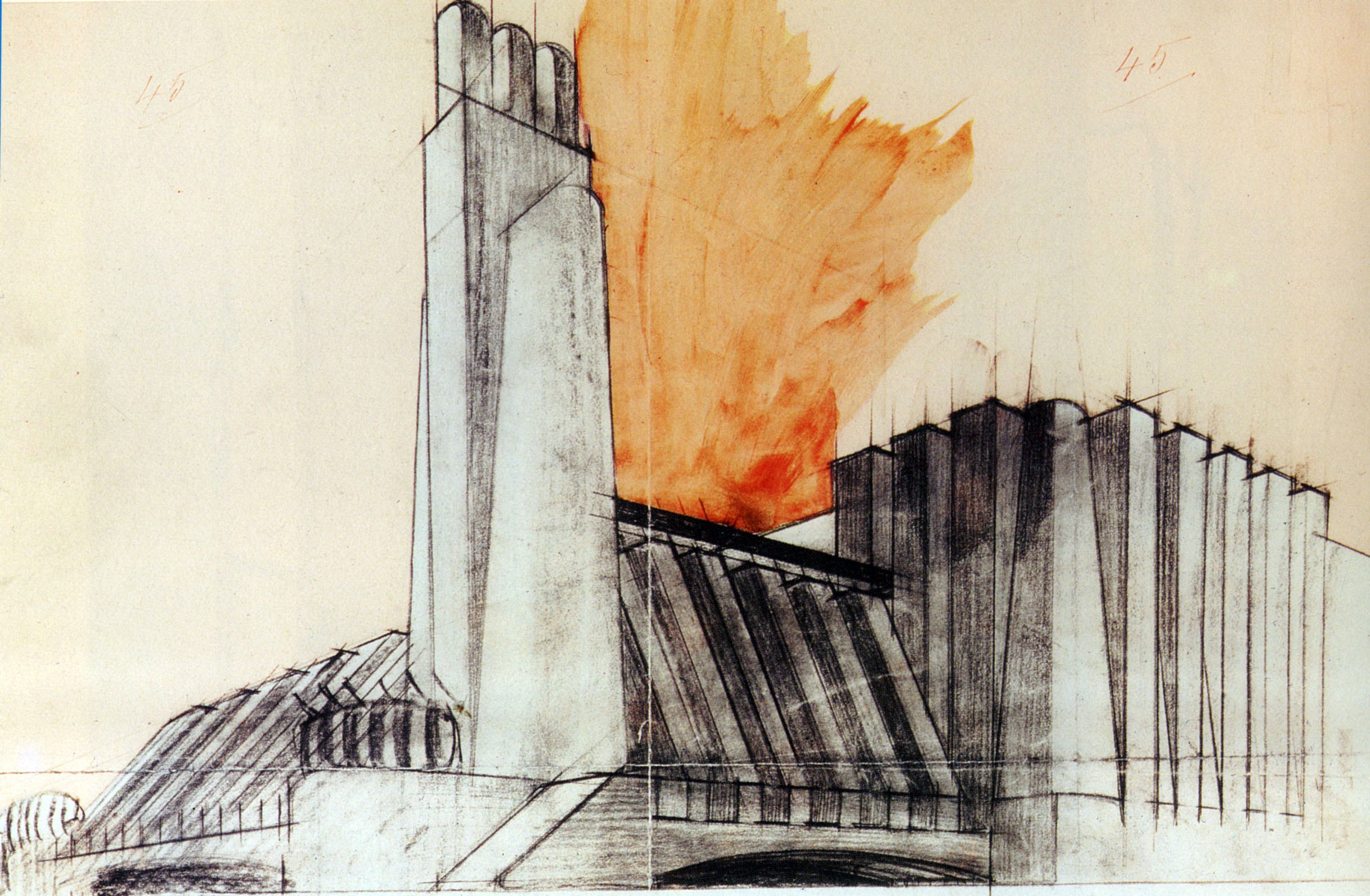
Antonio Sant’Elia’s 1914 Manifesto of Futurist Architecture likewise scorned the “architectonic whoring” of early twentieth-century Italian architecture, which persisted in rehashing moonlit dreams of antiquity amid enormous transformation. “They obstinately persevere,” he wrote,
Armed with rules laid down by Vitruvius, Vignola, and Sansovino… restamping the centuries-old image of foolishness over our cities, cities that should instead be the immediate and faithful projection of ourselves…As if we, accumulators and generators of movement, with all our mechanical extensions of ourselves, with all the noise and speed of our lives, could ever live in the same houses and streets constructed to meet the needs of men who lived four, five, or six centuries ago.
This is the highest imbecility of modern architecture, which is perpetuated through the mercantile complicity of the academy, that forced residence for intelligence where the young are constrained to an onanistic recopying of classical models, instead of having their minds opened to research into the limits and into the solution of that demanding new problem: the Futurist house and city. The house and city that should be spiritually and materially ours, where our restless activities might unfold without seeming a grotesque anachronism.
Set against this demand, contemporary urban and architectural discourse appears thin. MAGA and the new right ostensibly broke established political frames, shattered the Overton window, and opened a cultural renaissance, yet rightist takes on cities and space only ever vacillate between nostalgia for the suburbs of childhood and valorization of neoclassical architecture. Trump’s Executive Order “Promoting Beautiful Federal Civic Architecture” promised a “return to the magnificent classical style of Western civilization.” Others, positioned as more dynamic, continually propose reviving Art Deco – a powerful but also now-archaic style produced in the specific interwar conjuncture of industrial acceleration, mass electrification, and American confidence in technological progress.
Meanwhile, nothing ever happens. American urban theory and practice, broadly speaking, remain structured by ideological uniformity: a generic “Last Urbanism” that reflects and reinforces a leveled form of life that is neither aspiring nor vital. Multifamily housing, carbon neutrality, and green infrastructure rendered through copy-paste plaza greens and bland mixed-use development cannot be the telos of urban form. Jane Jacobs’s declaration that “a city cannot be a work of art” is not a fact but an assertion designed to arrest more vital possibilities.
Rather than responding to the transformations of their time with fear or restraint, the Futurists embraced their reality as an aesthetic and existential provocation. Their world was accelerating and dissolving and they responded by aggressively demanding new orders, new disciplines of form, and new spatial intensities. For this they sought forms capable of escalating and crystallizing the most dynamic, hardest, and also most poetic edges of modernity.
Even their most destructive rhetoric was to clear ground for coherence— “world’s only hygiene,” like a forest fire. Their aggression was also tied with love – intolerance for banality or degraded potential in the city they addressed. “Venice – we have loved it long and possessed it in the anguish of a great delightful dream…”
An intellectual change of front
The New Aesthetics call locates its key point of inspiration in the Bauhaus, which responded to a similar historical conjuncture as Italian Futurism but in a different way. Founded in Weimar in 1919, just after the First World War and a decade after Marinetti’s Futurist Manifesto appeared in Le Figaro, the Bauhaus emerged in a context of social collapse and cultural exhaustion. A school and milieu where the international avant garde met and Germans of all kinds, including youth and war veterans, came to explore the building of the future, the Bauhaus was a futurist project of its own kind concerned less at first with producing new styles or objects than with transforming the conditions of artistic thought and production. As Walter Gropius later recalled of postwar Germany, “every thinking man felt the necessity for an intellectual change of front.”
Where Italian Futurism was bold, provocative, and aggressive, the early Bauhaus approached the crisis more obliquely. They had moments of iconoclasm –students famously dumped paint onto statues of Schiller and Goethe in what they saw as hopelessly trad Weimar— but the school’s deeper orientation lay elsewhere. The Bauhaus began from the recognition that modern technologies –mechanization, industrial production, photography, film, electric light, print— had already transformed perception and spatial orientation. Inherited concepts of art, architecture, and space no longer aligned with lived reality. The problem was not simply that older styles were obsolete, but that the conceptual and perceptual frameworks that produced them had ceased to function.
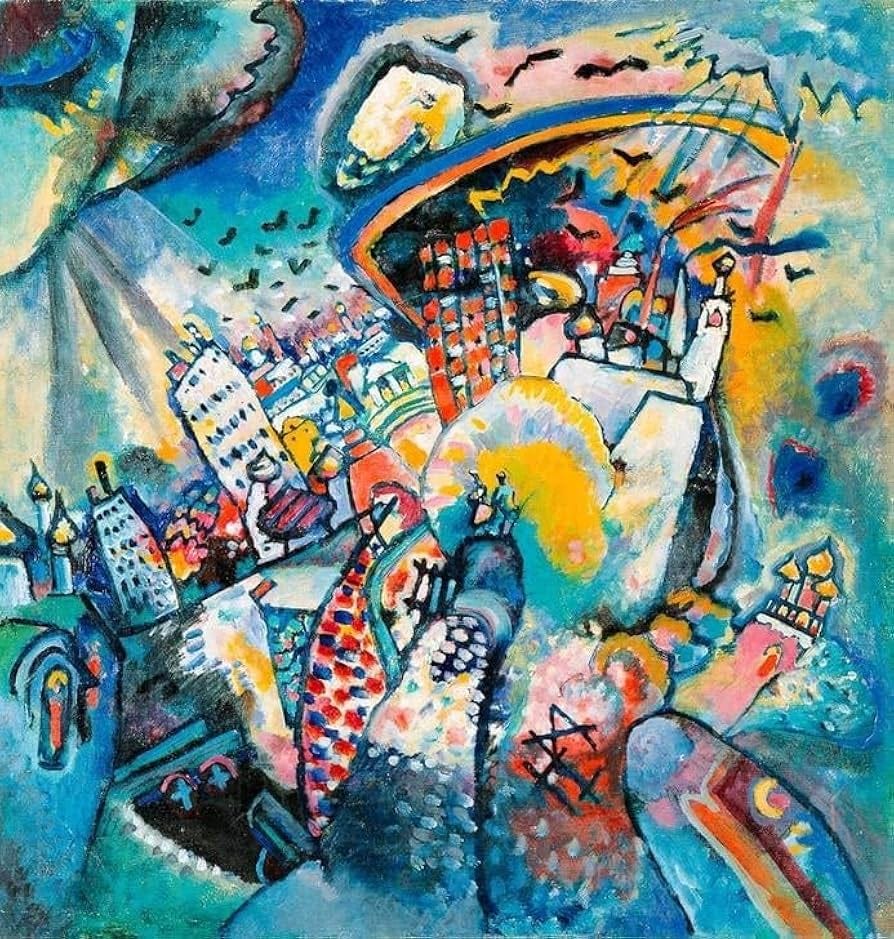
In this sense, the early Bauhaus understood the crisis of architecture and urban space as a crisis of thought – of how space was apprehended, how materials were understood, and how sensing subjects oriented themselves physically and existentially within increasingly dynamic environments. Before new architectures could be designed, these conceptual categories had to be rebuilt. Rather than rushing toward a new aesthetic, the school treated the misalignment between form and life.
The aim of the early Bauhaus was therefore to reconstruct the conditions under which form —including spatial and architectural form— could be produced at all. Through pedagogy, shared conversations, parties, and overall experimentation, it sought to retrain perception, reorganize sensory experience, and develop new modes of thinking and making adequate to modern life. Exercises in the Vorkurs, workshops, and performance were used as probes –they were tests of perception rather than applications of theory to reality. Bauhaus concepts emerged from these structured investigations. It approached architecture not as a building or object, but as the organizing horizon for thought and making.
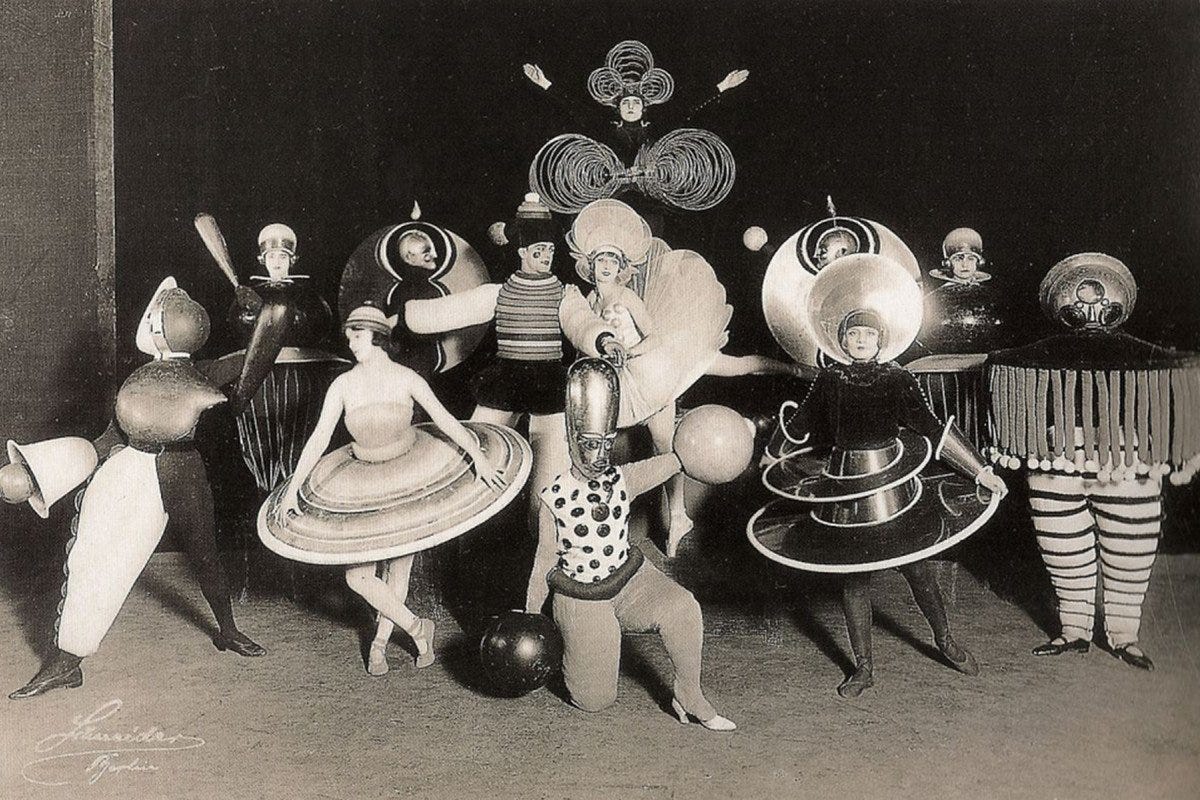
The Bauhaus operated as a laboratory and milieu rather than a school in the narrow sense. It assembled painters, architects, dancers, craftsmen, designers, typographers, and theorists into an ecosystem of cross-pollination. Classes and workshops existed alongside talks, paintings, buildings, and performance, including experiments such as Oskar Schlemmer’s Triadisches Ballett, which treated dance as uniquely unburdened by tradition and therefore capable of evolving new relations between bodies and space. Influenced by Lebensreform, many Bauhaus teachers and students also explored sensual and bodily experimentation, including anti-bourgeois sexuality, understood not as transgression for its own sake or political ideology but as life, and a means of recalibrating the senses to its new textures. The project of overall sensual reeducation was foundational to the school’s attempt to realign perception, thought, and making.
As Mat Dryhurst has observed, the Bauhaus was initially a new school of thought rather than an aesthetic program. Beauty and strangeness emerged only as secondary effects of its more fundamental reshaping of artistic ambition and practice within a experimental milieu. In this early phase, the Bauhaus functioned as a laboratory organized around shared inquiry rather than stylistic or ideological coherence. Its ambition was not yet functionalist or managerial, but exploratory. It was concerned with rebuilding the conditions under which form, design, and eventually urban life could become thinkable again.
Revolatilize urbanism
What could today’s much-talked-about “new cities” or “frontier cities” become if approached with contemporary versions of the wild futurist impulse? Could the Marc Andreessen-backed California Forever become something far more than walkable reindustrialized urbanism with 3D-printed Greco-Roman statuary? Andreessen’s Techno-Optimist Manifesto declares a belief in adventure, in the eros of technology, skyscrapers, rockets, and neural networks. But do we really believe in this? If we did, what would we do?
Taken together, Italian Futurism and the early Bauhaus clarify how much more demanding earlier attempts were than our own, and the different registers in which the futurist impulse has historically operated. One confronted the failure of inherited form with maximal intensity; the other rebuilt the perceptual and conceptual conditions under which new forms could become thinkable again. Set against these attempts, contemporary urban ambition appears hollow. We should be burning the gondolas and building our own cathedrals.
Since its inception, America has been an archeofuturist nation: rooted in an ancient spirit and therefore wild and untamed. Its energies have rarely been preservationist. They have been exploratory, animated by risk and willingness to abandon inherited forms in pursuit of new ones. If the recent American moment felt briefly charged with possibility, it was because culture detached, however fleetingly, from conservatism and became inventive and open-ended. If anything is still salvageable from that moment, it lies in recognizing the present as a time for wild experimentation.
What can be taken from earlier futurist attempts is not a catalog of forms to revive, but an understanding of how aesthetics actually emerge: through shared intellectual and creative experimentation conducted in search of forms adequate to the technological, cultural, and subjective mutations of one’s own time. Futurism, in this sense, is not an ideology but a practice to be reinvented in each era.
Fixation on classicism, faded Americana aesthetics, or endlessly recycled Art Deco is inadequate to the present moment. Required are wild forms of spatial thought and design capable of touching the radicalism of our contemporary conditions.
In The Aesthetic Rebirth of America Rachel Haywire calls for a renewed futurist practice to emerge from America’s present crises. While it is not clear that any futurism, or anything, can emerge from the present chaos, if it does it will likely begin with the urban. Urbanization is now planetary. The city is our milieu, and it is where contemporary crises, potentials, and desires intersect most visibly. The contemporary city is simultaneously feral and domesticated; a space in which vitality is increasingly constrained. Computational technologies are integrating into urban space; social interaction is entangled with digital systems; autonomy and robots reshape the visual and physical fabric. These transformations are altering urban life not only materially, but psychologically and existentially.
From the early Bauhaus we understand that this condition demands new intellectual frameworks and shared languages for understanding and intervening in transformed environments. The philosophical and theoretical concepts we inherit are outdated and ideologically overcoded; they are poorly equipped to grasp the mutations now underway. From Italian Futurism, we are reminded of the need for our own spatial visions and a far more aggressive intolerance for urban banality and pastiche.
New spatial visions are required to reestablish the city as a leading edge of culture and strategy –where new ways of living, sensing, and perceiving can be tested. Any serious imagining of the future will have to grapple with how urban space reshapes desire, risk, fertility, and perception, and explore how to re-volatilize city life.
But no urbanism emerges from a vacuum. By urbanism we should understand not a single plan or text but a shared conceptual and practical apparatus forged across architecture, design, art, theory, visualization, and speculation –elaborated through texts, debates, exhibitions, projects, and institutions. This is how new forms –cultural, intellectual, and aesthetic— have always emerged. At minimum, we need a Bauhaus-esque institution adequate to the horizons of the twenty-first century. But also a lot more.
New Year’s Eve
On the cusp of 2026, it feels as though the window for serious experimentation is narrowing. Perhaps nothing really ever does happen. But let’s at least try and see:
Instead of selling off federal land parcel by parcel HUD could designate certain territories as experimental urban zones – places where new forms of life, work, and spatial organization could be tested under provisional rules and extreme temporal pressure. No OSHA, no EPA, no permits, no zoning, no codes. Imagine what could be attempted in a year in a protected experimental sanctuary?
California Forever could decide to become the vanguard of this. Rather than just a competent development, it could position itself as a site of intellectual and spatial confrontation: charrettes, symposia, and competitions that force architects, artists, and theorists to think seriously about what 21st century American urbanism might become, rather than what we already know how to reproduce.
El Segundo - it’s already an unusual concentration of aerospace, defense, and AI, and American spirit. Could it position itself as the first explicitly human-machine teamed city? What would that look like, spatially and socially?
Praxis speaks of “sovereign intelligence.” What would this mean in urban terms? What kinds of spatial arrangements, institutional forms, and subjectivities would such a concept involve?
Remilia’s quasi-mythical white paper Minecraft city: what kinds of maneuvers exist when a city exists partly online and partly as symbol and only intermittently as physical territory?
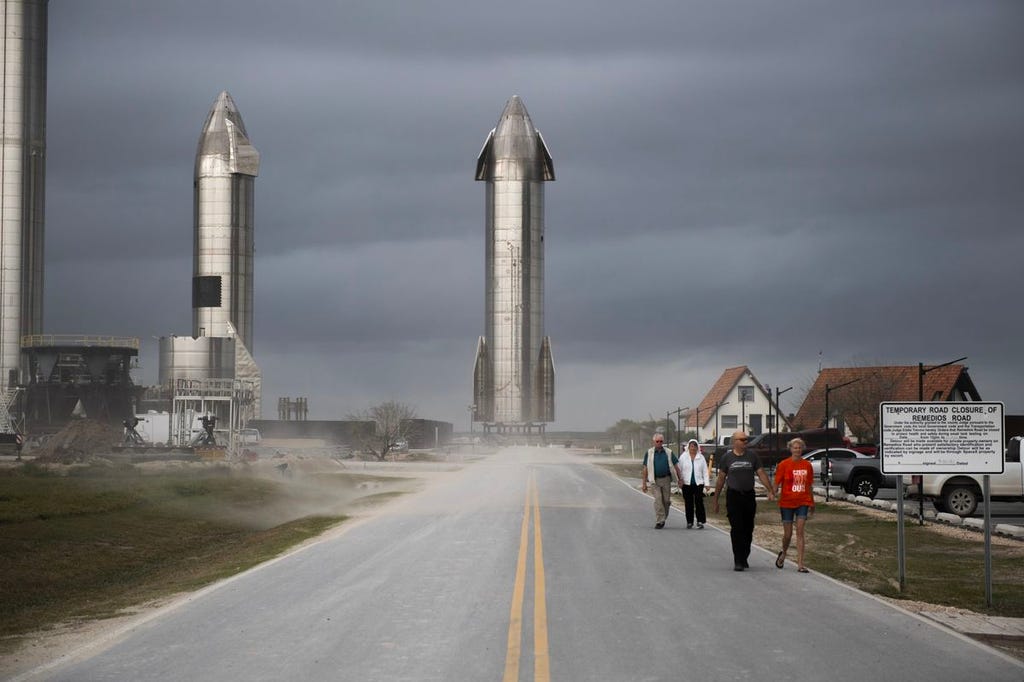
Starbase, TX is like an accidental prototype, launch site that’s begun to thicken into a settlement coupling engineering, architecture, and frontier logic. Could this frontier urbanist aspect be accentuated and if so how?
Network states – why are they still kind of boring?
It’s 2026. Art is long and time is short.
This is truly great writing and analysis. The first response to that call that feels thoughtful.
Reminds me of Art Nouveau—bloomed in the age of smokestacks and assembly lines, when the factory was becoming the default language of the world. Instead of copying the machine, it drew vines, insects, hair, smoke, stained glass light. A soft sabotage. A way of saying: if industrial life is going to swallow everything, at least let the surface of life stay human.
Bauhaus is the next turn of that argument, and Walter Gropius is the hinge. He does not romanticize craft the way Art Nouveau sometimes did. He tries to train the machine. He turns design into education, into discipline, into a repeatable method, and that becomes a pipeline. Then he lands in Cambridge, helps shape Harvard’s Graduate School of Design, and the “future” leaks out of classrooms into neighborhoods. That Lexington story says it plainly. A colonial town full of capes, then suddenly, in the mid-1960s, glass and flat roofs and Eames chairs appear a few blocks away. Not because someone invented a vibe. Because an ecosystem formed. School, studio, affordable land, a community of builders who could actually try a new way of living.
And then the objects caught up. New materials changed what was possible at scale. Plastics, laminates, aluminum, fiberglass, new coatings. Curves got cheaper. Surfaces got smoother. Kitchen appliances looked like they were about to fly off the shelves.
But the deeper driver was narrative. The Space Age was a call that pulled form behind it. “New Frontier” first, then the appliances, the houses, the Jetsons sheen. The future did not show up and then get named. It got named, loudly, and millions of people started building toward the name. If we want a new aesthetic now, we do not need a moodboard. We need a call, plus the schools, materials, and distribution that make that call real.
"What does the future look like?" might be a start. What I love about your take is asking, "What foundations make new futures inevitable?"
As a creative architect and designer practicing not far from and adjacent to the California Forever site, I can not believe that the forces of mass merchant house builders will bend to a new idea. What could define and has defined architecture is cost to build. Ornament through additive application of faux details or articulated facades that imply spatial complexity are the last referential bit of design that are being eliminated. What remains is a vanilla undistinguished container for people. Landscape architecture is even being affected by post fire storm thinking that prohibits trees that shade because they are flammable. And those that survive aren’t allowed to drink too much water due to scarcity.
So we’re left with less…less architecture, less space, less aesthetic character and places that have no feelings—no personality that echo Soviet central planning and not a Brazilian or Myanmarian new capital city.
The only option left is color. Paint. Buildings defined by colors that are codes for design the way ski outfits and skinny girl spandex stretching classes define.
Practically and American culture are the same and so are people. Individualism and social conformity are the safe havens for future architecture because no one will understand or have a reason to be different. Apple had tried to define the future back when they said to “think differently.” That’s gone.